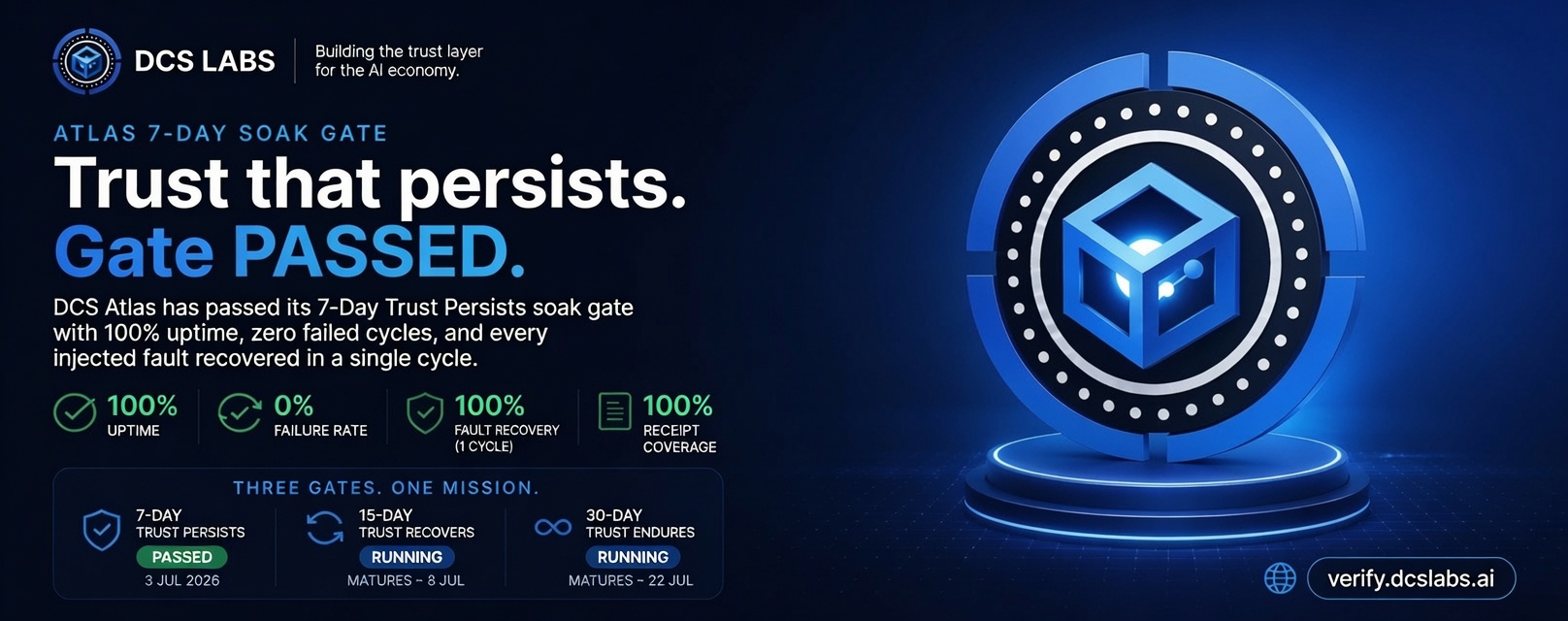
Trust That Persists — Atlas passes its 7-Day soak gate [WITHDRAWN 30 Aug 2026]
Gate result withdrawn 30 Aug 2026 — the soak's receipt verifier could not return false. Originally posted as: DCS Atlas has passed its first long-duration reliability gate, the 7-Day "Trust Persists" soak test. 60,448 continuous execution cycles, 100% uptime, zero failed cycles, 6 of 6 injected faults recovered within a single cycle, and 100% receipt coverage. Reliability under deliberate fault injection isn't an optimization — it's part of the product. The 15-Day and 30-Day gates are still running.
Round 1 is deployed and green — and still dark on purpose
Weekly achievements. The DCS gateway's Round 1 is deployed and green on api.dcsai.ai — twenty feature routes, an MCP tool layer, and migrations 023–036 — running behind flags that are still off. Verified against the live deploy by an internal, integrator-rerun smoke suite (8/8 routes) and an IDOR/authz money test (11/11, no cross-user leak, two real users), with Sentry + Grafana monitoring live and TLS/headers graded A+/A. Money and autonomy stay dark; only the founder flips it.
Scanning the worker SBT contracts before anything mints
Weekly achievements companion. A Slither 0.11.5 / solc 0.8.28 static-analysis pass over the DCS and TRD worker soulbound-token contracts returned zero High/Medium findings in custom code — the flagged High/Medium entries are OpenZeppelin Math.sol false-positives, and the only own-code finding is a benign Low reentrancy in mint(). The scan settled the choice to deploy the AccessControl (v2) build over the Ownable (v1) one. A static scan is a floor, not a full audit — and nothing mints on the strength of it.
The receipt boundary: a first outside product wires into DCS Verify
Weekly achievements. A quieter week on the core — and the piece that matters most is small: an external product is now wired to emit DCS Verify receipts through the gateway into DCS storage, conforming to our receipt shape. The proof it's real is two unglamorous fixes (UUID coercion for a Postgres 22P02) that only show up once data actually flows. Committed and pushed; the resolved live path is not yet independently verified.
DCS Intelligence is live: first-party analytics with an honesty rule
Weekly achievements. This week's biggest shipped surface is DCS Intelligence — our own analytics dashboard, deployed and network-verified live at intel.dcsai.ai on a first-party data spine, with PostHog feeding real traffic. The design constraint that shaped it: show a dash, never a guess, wherever a source isn't connected. Plus the DCS Verify build-flow wiring that's committed but not yet verified live.
One day, sixteen deploys: the R-Series goes live end to end
First weekly achievements post. June 4–5: the Trust SKU verification API goes live on api.dcslabs.ai, post-quantum hybrid co-signatures deploy dark behind an 8-verifier regression gate, the verify app ships as a PWA with an honest build-time status page, and trdn.io moves to the new stack — plus the sandbox-prove, flags-off, one-flip-at-a-time discipline behind 1,400+ internal, integrator-rerun checks.
Coming live: DCS AI Technologies and the R+2 Open Provenance Standard
After a ~41-day intensive build, DCS AI Technologies launches with R+2, an on-chain agent identity contract on Base mainnet, two npm packages, the Project Fifty agent stack, and three sectoral profiles for government, healthcare, and finance. Every claim independently verifiable.
Why Ed25519 and RFC 8785 — defending the R+2 primitives
Long-form defense of the cryptographic choices in R+2. Why Ed25519 over ECDSA/RSA/BLS. Why RFC 8785 canonical JSON over ad-hoc canonicalization. Why SHA-256 not BLAKE3 or SHA-3 in v0.1. What the post-quantum migration path looks like.