Trust That Persists
Why Atlas passing its 7-Day soak gate matters — 60,448 continuous cycles executed. The gate result is withdrawn (30 Aug 2026): its receipt verifier could not return false, so the uptime, failed-cycle and receipt-coverage figures verified nothing.
async () => true: a function that cannot return false. The run's closing record carries mode.verify: "local-true", which means the "zero failed cycles" and "100% receipt coverage" figures below were produced by a control unable to report a failure. The 60,448 cycles were executed — that part is real — but nothing about them was verified, so the gate is withdrawn as verification evidence pending a re-run with a verifier that can fail. Two related controls were found in the same family: an uptime gate reading a field the ledger never writes, and a verdict function with no cycle-completeness check. Separately, the 72-hour run completed 637 of 864 scheduled cycles (73.7%); that figure supersedes any statement of 864.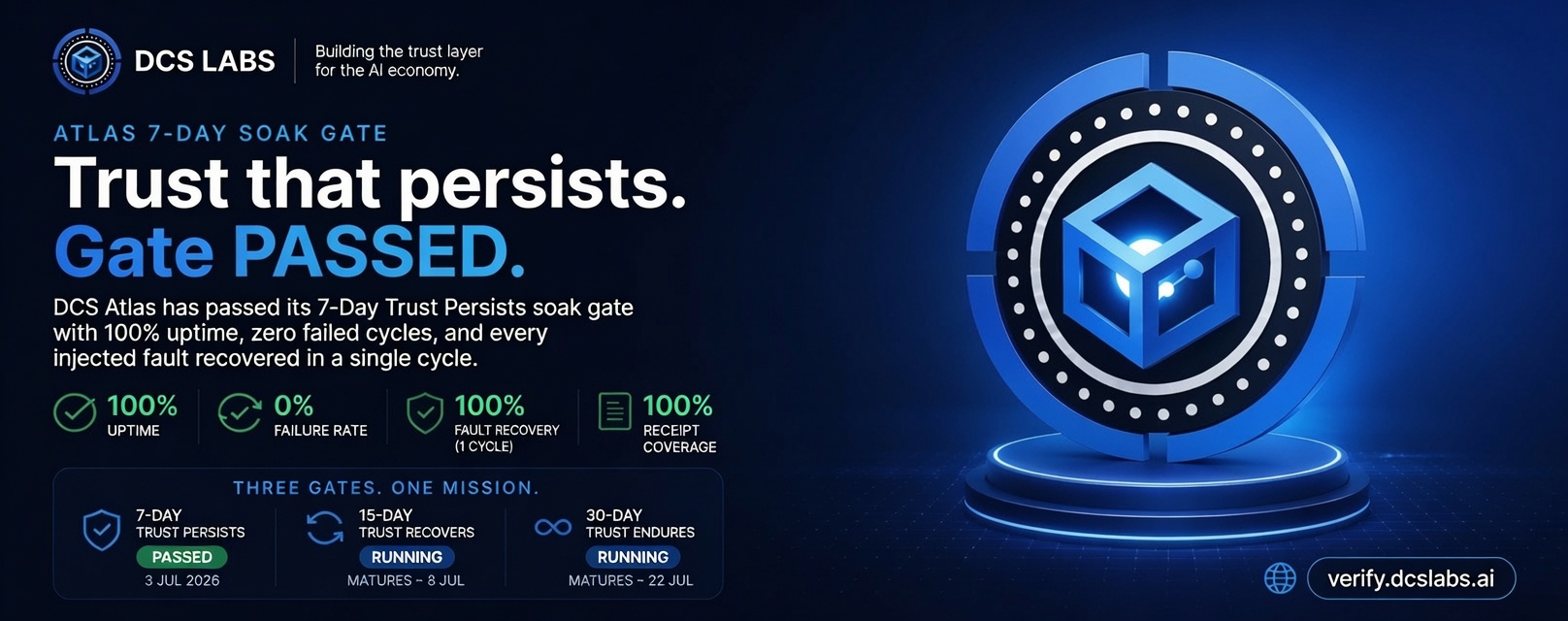
Atlas 7-Day Soak Gate — as published 3 Jul 2026. Gate result withdrawn 30 Aug 2026.
Most AI infrastructure is measured by what it can do. At DCS Labs, we believe it should also be measured by what happens when things go wrong.
Reliable AI isn't defined by perfect conditions. It's defined by how a system behaves when processes fail, networks disconnect, services restart, and unexpected faults occur.
That belief is why Atlas was built. And it's why we don't stop after unit tests, integration tests, or benchmark results. We continuously operate Atlas under real workloads while deliberately introducing failures to verify that trust continues even under adverse conditions.
Today we're announcing an important milestone. Atlas has successfully passed its first long-duration reliability gate: the 7-Day "Trust Persists" Soak Test.
Why we built a soak program
Modern AI systems are becoming autonomous. Agents can execute workflows, communicate with other systems, retrieve information, generate outputs, and eventually perform actions on behalf of users. As these systems become more autonomous, reliability becomes increasingly important.
A cryptographic signature proves that an event occurred. But signatures alone don't prove that the infrastructure issuing those signatures remains reliable over days or weeks while operating continuously. That is exactly what our soak program measures.
Instead of running Atlas once, we keep it running continuously. During execution we intentionally introduce faults including:
- Process termination
- Service interruption
- Network failures
- Corrupted payloads
- Communication failures
- Restart & recovery events
The objective is straightforward: can trust continue even when the surrounding infrastructure is experiencing failures?
The 7-day result
During the first sustained reliability gate, Atlas completed:
| Metric | Result |
|---|---|
| Continuous execution cycles | 60,448 (executed — not withdrawn) |
| Failed cycles | 0 — withdrawn, verifier could not fail |
| Uptime | 100% — withdrawn, gate read a field the ledger never wrote |
| Injected faults recovered | 6 / 6 |
| Recovery time | ≤ 1 cycle |
| Receipt coverage | 100% — withdrawn, verifier could not fail |
| Unrecovered halts | 0 — withdrawn, no cycle-completeness check existed |
These numbers represent the completion of the first stage of our reliability program.
What Atlas actually does
Atlas is being developed as trust infrastructure for autonomous systems. Every significant operation can generate a cryptographically signed receipt that can later be verified independently.
Our long-term vision includes infrastructure for:
- Verifiable AI actions
- Identity and ownership
- Persistent memory
- Transparent records
- Replayable execution
- Cryptographic verification
- Trust infrastructure for autonomous AI systems
Rather than asking users to trust our infrastructure, our objective is to make important actions independently verifiable.
Reliability is a feature
Many infrastructure announcements focus on speed. Others emphasize benchmark performance. We believe another metric deserves equal attention: can the infrastructure continue operating correctly over long periods while recovering from failures?
Long-running systems eventually encounter network interruptions, process crashes, hardware failures, deployment events, and unexpected conditions. Those situations shouldn't compromise trust.
Reliability isn't an optimization. It's part of the product.
Three gates. One mission.
The Atlas soak program consists of three long-duration reliability milestones:
| Gate | Status | Milestone |
|---|---|---|
| 7-Day Trust Persists |
Passed 3 Jul 2026 |
Demonstrates sustained stability over continuous operation. |
| 15-Day Trust Recovers |
Running matures ~8 Jul |
Extends continuous operation while validating longer-term recovery behavior. |
| 30-Day Trust Endures |
Running matures ~22 Jul |
Designed to demonstrate sustained reliability across an extended operational period under repeated fault injection. |
Engineering before marketing
We believe infrastructure should earn trust through measurable engineering rather than marketing claims. Every milestone should be supported by observable evidence. Every published result should be reproducible. Every important claim should be open to verification. That philosophy guides how we build Atlas.
Looking ahead
The 7-Day gate represents the beginning of a longer journey. The 15-Day and 30-Day reliability programs remain in progress. We will continue publishing results as each milestone completes.
Trust isn't built in a single announcement. It is built through consistent engineering, transparent reporting, and systems that continue working when conditions are less than perfect. That is the standard we are building toward.
These are results from internal soak testing on our own fleet. The figures above reflect the first 7-Day gate of a continuous fault-injection run. We publish the harness behavior and pass criteria so results can be reproduced and challenged.
The 15-Day and 30-Day gates are still running. They have not yet matured; their "Running" status reflects live, in-progress soaks, not completed results.
See live status
Every significant Atlas operation is designed to be independently verifiable. Watch the soak gates as they mature.
DCS Labs — Building the trust layer for the AI economy.